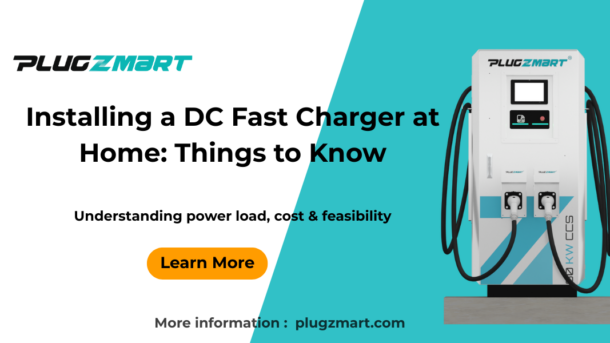
A lot of new EV owners eventually ask the same question: “Can I install a DC fast charger at home?” The idea is tempting. Who would not want to charge their car in minutes instead of hours? But before you start browsing for a 30 kW or 60 kW unit online, let us break down what this involves, what is realistic, and whether it even makes sense for a home setup in India.
Start with the hard truth: DC chargers are not built for homes
Most homeowners think upgrading a charger is like upgrading a Wi-Fi router. You spend more; you get faster results. But DC fast chargers work on a totally different scale. They are not simple units you hang on a wall.
A DC charger needs:
- High power draw
- A dedicated transformer
- Serious wiring upgrades
- Cooling systems
- Professional commissioning
That alone pushes it out of the “home appliance” category.
Check your sanctioned load before going any further
This is the part most people underestimate. Even a “small” DC fast charger, say 30 kW needs way more power than the average home connection provides. Typical households run on 3 kW to 10 kW sanctioned load. You can already see the gap.
To support DC charging at home, you would need:
- A massive sanctioned load increase
- A dedicated HT line
- Utility permissions
- Space for external electrical equipment
This is not something DISCOMs approve overnight.
Understand the real meaning of fast charging
AC charging relies on your car’s onboard charger. DC charging bypasses it entirely and talks directly to the battery. That is why it is faster but also why it needs industrial-grade infrastructure.
If your EV supports 50 kW DC charging and you try installing such a charger at home, the power demand and heat output will overwhelm a standard residential setup.
This is why DC chargers built by companies like Plugzmart, Exicom, Magenta or Delta are usually meant for:
- Malls
- IT parks
- Fleet depots
- Highways
- Logistics hubs
- Commercial EV hubs
They are not designed for individual driveways.
Cost is another reality check
A DC fast charger from any reputable EV charger manufacturer in India will cost significantly more than even the best AC home charger. Add electrical upgrades, civil work, permissions and safety equipment and the cost does not just double, it multiplies.
If your goal is daily charging for a single EV, a high-quality AC charger like Plugzmart’s 7.4 kW or 22 kW unit will serve you better without tearing up your electrical system.
Your EV battery will thank you
Fast charging is great when you are traveling or running a commercial fleet. But using DC fast charging daily can heat the battery, increase wear, and reduce long-term life.
Most EV manufacturers actually recommend:
- Daily AC charging
- Occasional DC charging
A home DC setup flips that pattern in a way that is not healthy for your battery long-term.
If you still want a DC charger at home, here is what the process looks like
It is possible. Just not simple.
You will need:
- A technical feasibility checks from your DISCOM
- A sanctioned load upgrade request
- Space for a transformer or high-capacity feeder
- Permissions from your municipality or electricity department
- A certified installer who can work with high-voltage DC equipment
- A compatible DC charger from an Indian manufacturer like Plugzmart, Delta, Servotech or Magenta
Most homeowners drop the idea once they see steps one and two.
A smarter approach: High-power AC chargers
If you want faster home charging without the chaos of DC installation, a 7.4 kW or 22 kW AC charger is the practical middle ground.
They are perfect for:
- Villas
- Gated communities
- Apartments with upgraded panels
Plugzmart’s AC chargers are popular for this reason — they’re smart, durable, OCPP-ready and built specifically for Indian voltage fluctuations.
You get:
- Faster charging
- Lower infrastructure cost
- Compatibility with all major EVs
- Less battery degradation
- A simpler installation process
It’s the realistic way to get “fast” charging at home without turning your property into a mini substation.
What this really means
Installing a DC fast charger at home sounds cool, but it only makes sense if you’re running:
- A fleet
- A taxi operation
- A commercial parking space
- A business with multiple EVs
- A guest-facing location like a hotel or mall
For everyone else, a reliable AC charger is the smarter, safer, and more cost-effective option.
If you are unsure what your home or property can support, Plugzmart can help you figure it out the easy way. No jargon. No unnecessary upselling. Just clear advice based on your power setup and your EV.
FAQS :
Can I install a DC fast charger at home?
Technically yes — but practically, it’s extremely difficult. DC fast chargers need industrial-grade power, a dedicated transformer, high electrical capacity, and utility approvals. Most homes in India are not designed to support this.
Why aren’t DC fast chargers suitable for homes?
DC chargers draw massive power (30 kW–60 kW or more), require cooling systems, heavy wiring, and professional commissioning. They are built for commercial environments like malls, highways, and fleet hubs not residential spaces.
Will DC fast charging every day damage my EV battery?
Frequent DC charging increases battery heat and accelerates long-term wear. Manufacturers recommend using AC charging for daily use, and DC charging occasionally — such as during trips.