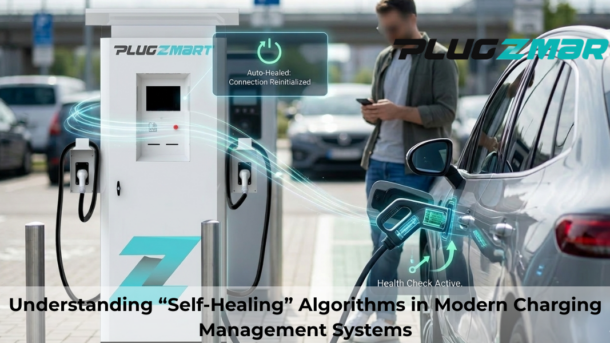
If you have spent time operating EV chargers, you know the uncomfortable truth. Things break, often quietly. A charger goes offline. A session fails midway. Communication drops for a few minutes and then comes back. By the time someone notices, users are already frustrated.
Self-healing algorithms exist to deal with exactly this problem.
They do not make chargers magically indestructible. What they do is detect, isolate, and recover from common failures automatically, without waiting for human intervention.
Let us break down what self-healing really means in the context of modern charging management systems and why it matters.
Why Traditional Monitoring Is Not Enough
Most charging networks already monitor uptime. They know when a charger is online or offline. That is useful, but it is reactive.
A charger can be technically online and still be unusable. Sessions may fail to start. Payments may not go through. Communication might be unstable. These issues often fall into a gray area where nothing triggers an immediate alert, yet the user experience suffers.
Self-healing systems look beyond basic uptime and focus on behaviour.
What a Self-Healing System Actually Does
At a high level, self-healing algorithms continuously watch for abnormal patterns and take corrective action automatically.
They typically respond to issues such as:
- Repeated failed start attempts
- Stalled charging sessions
- Inconsistent meter readings
- Intermittent OCPP communication drops
- Chargers stuck in an incorrect state
- Firmware processes that hang without crashing
Instead of waiting for a technician or operator, the system intervenes in real time.
Common Self-Healing Actions in Charging Networks
Self-healing does not mean one big dramatic fix. It is usually a series of small, controlled actions.
Typical responses include:
- Soft resets of the charger backend connection
- Reinitializing OCPP sessions
- Restarting specific charger services rather than full reboots
- Clearing corrupted session states
- Re-syncing charger status with the CMS
- Temporarily isolating a faulty connector while keeping others active
These actions are designed to be safe, reversible, and minimally disruptive.
How Algorithms Decide When to Intervene
This is where the intelligence comes in.
Self-healing systems rely on rules and learning models built from historical data. They understand what normal behaviour looks like for a charger model, location, and usage pattern.
For example:
- Two failed sessions in a day may be normal
- Ten failed sessions in an hour is not
- A brief communication drop during a grid event is expected
- Repeated drops every evening at the same time are not
By comparing real-time data against learned baselines, the system knows when to act and when to stay quiet.
Why Self-Healing Improves Uptime Without Hiding Problems
A common concern is that automatic recovery might mask deeper issues. Well-designed systems avoid this.
Every self-healing action is logged. Repeated interventions trigger escalation. If a charger keeps needing resets, the system flags it for manual inspection.
The goal is not to hide failures, but to:
- Reduce unnecessary downtime
- Prevent small issues from becoming major outages
- Buy time for planned maintenance instead of emergency fixes
The Business Impact for Operators
For charging operators, self-healing has very real benefits.
It leads to:
- Fewer user complaints
- Higher session success rates
- Reduced support tickets
- Lower operational costs
- Better perceived reliability
In high-traffic locations, even small improvements in uptime translate directly into higher revenue and better utilization.
Why Self-Healing Depends on a Strong CMS
Self-healing is not a feature you can bolt on later. It depends on deep integration with the charging management system.
The CMS needs:
- Real-time visibility into charger states
- Reliable two-way communication
- Fine-grained control over charger behaviour
- Detailed logs for analysis and escalation
Without this foundation, automation becomes risky instead of helpful.
What This Means for the Future of EV Charging
As EV adoption grows, manual intervention will not scale. Networks with hundreds or thousands of chargers cannot rely on people watching dashboards all day.
Self-healing algorithms turn charging networks into systems that can take care of themselves most of the time and call for help only when truly needed.
What this really means is simple. Reliability is no longer about reacting faster. It is about preventing failure before users ever notice.
In modern EV charging, self-healing is not a luxury. It is becoming the baseline expectation.
FAQS
What is a self-healing algorithm in EV charging systems?
A self-healing algorithm automatically detects common charger issues (like failed sessions or communication drops) and fixes them in real time without human intervention.
How does self-healing improve EV charger reliability?
It identifies abnormal behaviour early and performs quick actions such as resets, reconnections, or status re-syncs to keep chargers running smoothly.
. Do self-healing systems hide charger problems?
No. Every automated action is logged. If issues repeat, the system escalates them for manual inspection while minimizing downtime for users.