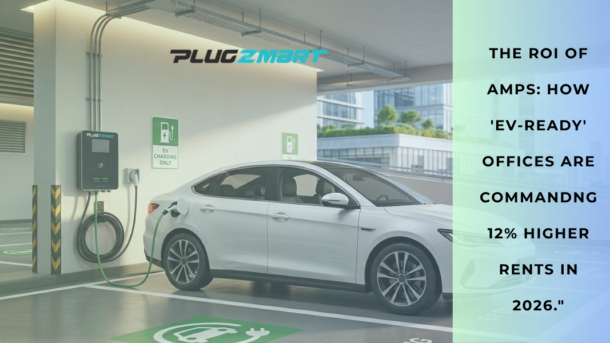
The landscape of corporate real estate in India has undergone a radical transformation. As we move through 2026, the criteria for “Grade-A” office space have evolved far beyond glass facades and high-speed elevators. Today, sustainability is the primary currency of commercial leasing, and at the heart of this shift is the EV chargers infrastructure.
For developers and facility managers, transitioning a property to be “EV-Ready” is no longer a forward-thinking luxury—it is a baseline requirement for asset preservation. With nearly every major MNC committing to Net-Zero targets, a building without a robust EV charging station installation strategy risks becoming a stranded asset.
The Shift from Amenity to Infrastructure
In the early 2020s, an EV plug in a basement was a “perk” for early adopters. In 2026, with electric vehicle penetration in the luxury and executive sedan segments crossing 20%, the demand has turned into a logistical necessity. Grade-A office spaces now cater to a workforce that expects seamless charging as part of their daily routine.
This shift has created the “EV Premium”—a measurable increase in property valuation and rental yields for buildings that offer high-speed, reliable charging. Developers are finding that corporate tenants are willing to pay a premium for facilities that help them meet their Scope 3 emission targets. By integrating Plugzmart EV Chargers, property owners are effectively future-proofing their investments against the inevitable decline of internal combustion engine (ICE) vehicles.
Operational Excellence: The Role of Smart Management
Installing the hardware is only half the battle. In a dense commercial environment, managing the load of fifty or a hundred vehicles charging simultaneously is a massive engineering challenge. This is where the distinction between a “plug” and a “smart system” becomes clear.
To avoid expensive grid upgrades and astronomical peak-demand charges, savvy developers are utilizing a Plugzmart EV Charging Management System. This software allows for dynamic load balancing, ensuring that the building’s power supply is never overstressed. It prioritizes vehicles based on dwell time and battery levels, turning a potential electrical nightmare into a streamlined, automated process.
Why ‘EV-Ready’ Drives Grade-A Value
1. Attracting High-Value Tenants
Global tech giants and consulting firms have strict ESG (Environmental, Social, and Governance) mandates. They are actively divesting from properties that do not support their green initiatives. An EV-ready building is a prerequisite for securing long-term leases with these high-credit-rating tenants.
2. Earning Green Building Credits
Integration of EV infrastructure is a significant contributor to LEED and IGBC Platinum ratings. These certifications are directly tied to lower interest rates on “Green Loans” and higher capital appreciation.
3. Revenue Generation Opportunities
While many offices offer charging as a subsidized benefit, many are turning their parking lots into revenue centers. By using a Plugzmart White-label CMS, facility managers can implement their own branding and billing structures, allowing for a structured ROI on the initial equipment cost.
Trends in Commercial Charging for 2026
The current trend is moving toward a mix of charging speeds. While home charging satisfies the overnight needs of employees, the office must provide a blend of AC destination chargers for long-stay employees and at least one DC fast charger for visitors or fleet vehicles requiring a quick top-up between meetings.
Furthermore, we are seeing the rise of “Power-as-a-Service,” where third-party operators manage the entire charging ecosystem, sharing the revenue with the building owner. This removes the operational burden from the facility manager while ensuring the hardware remains state-of-the-art.
FAQ:
Does installing EV chargers require a new transformer?
Not necessarily. With smart load management, you can often distribute existing power more effectively, allowing for multiple charging points without exceeding your sanctioned load.
How do we bill individual employees or tenants?
Modern CMS platforms allow for RFID or App-based authentication. This enables precise tracking of energy consumption per user, allowing for automated billing or payroll deductions.
Is it better to install AC or DC chargers in an office?
A Grade-A office should ideally have a 90/10 split. 90% should be AC chargers (7.2kW or 22kW) for employees who stay for 8-9 hours, and 10% should be a DC fast charger for guests and quick turnarounds.