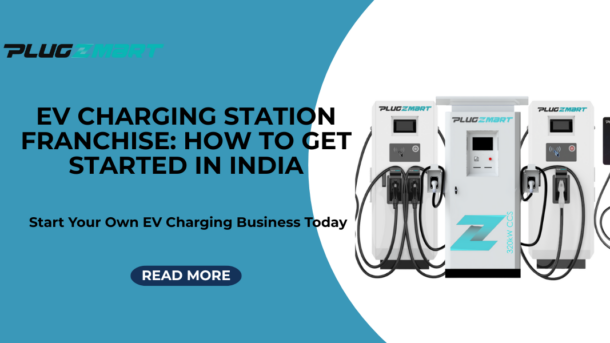
If you have been keeping an eye on the EV space, you have probably noticed how quickly charging stations are popping up across highways, malls, tech parks, and residential zones. What a lot of people do not realise is that a good chunk of these stations is run by private franchise owners, not big corporations.
So, if you are thinking about entering the EV charging business, starting a franchise can be one of the simplest ways to get in. Let us break down what it actually takes, what matters, and how you can build something profitable from day one.
Start by Understanding the Business Model
Here is the thing: EV charging is not like opening a restaurant franchise. It is more of an infrastructure play. You are setting up a service that customers use daily, and the money comes in quietly but consistently.
Most charging franchises in India work on one of these models:
1. Pay-per-use model
EV users pay for every charging session. You earn a percentage.
2. Revenue-share with a CPO
You provide the location and power; the Charge Point Operator handles installation, operation, and maintenance.
3. Fully owned station
You buy the chargers yourself and keep the maximum share of earnings, but you handle the risk.
The model you choose depends on your budget, location and how hands-on you want to be.
Choose a Location That Actually Makes Sense
EV charging is all about convenience. The best locations tend to be:
- Highways
- Hotels
- Restaurants
- Malls
- Gated communities
- Office parks
- Fleet hubs
- Large residential layouts
If your location has steady vehicle flow, you are already halfway there. A good parking layout and a reliable power supply matter just as much.
Decide Between AC and DC Chargers
A lot of new franchise owners get confused here. AC chargers are slow but affordable and perfect for destinations where people spend time. Malls, offices, residential communities.
DC chargers are fast, expensive, and ideal for highways, fleets, and commercial parking.
If you are starting small, a mix of 7.4 kW or 22 kW AC chargers is usually enough. If you are near a highway or running a commercial hub, a 30 kW or 60 kW DC charger earns faster.
This is where Indian manufacturers like Plugzmart, Delta, ExiCom and Magenta come in. They offer AC and DC chargers built for Indian temperatures, voltage fluctuations, and heavy usage.
Understand the Real Costs
Let us keep this simple. Your costs fall under four buckets:
1. Hardware
AC chargers range from affordable to mid-range.
DC chargers cost significantly more.
2. Installation
Cable routing, breakers, panels and on-ground work.
3. Power upgrades
Some sites need sanctioned load increases.
4. Software
You need a CMS (charging management system) to track sessions, payments, uptime, and tariffs.
Some manufacturers, like Plugzmart, bundle this into the charger.
Once you know all four, the business math becomes clear.
Pick a Technology Partner You Can Actually Rely On
You do not want a charger that works great for three weeks and then burns out in summer heat. You also should not rely on imported hardware that nobody in your city knows how to fix.
This is why most franchise owners prefer Indian-made chargers from manufacturers like Plugzmart.
What you get is:
- ARAI-approved hardware
- Good uptime
- After-sales support
- Easy access to spare parts
- OCPP-ready software
- Compatibility with major CPO apps
You are not just buying hardware. You are buying peace of mind.
Get Your CMS and Payment System Sorted
An EV charger without a CMS is just an expensive box.
Your CMS should help you:
- Set charging tariffs
- Collect payments
- Track energy usage
- Monitor chargers in real time
- Get alerts when there is a fault
- Control access for different user types
Plugzmart’s CMS and OCPI-ready backend do exactly this. You get full visibility into your chargers without being physically present at the site.
Government Policies Are on Your Side
The EV ecosystem is heavily supported by state and central policies. Depending on your state, you may get:
- Subsidies
- Tax benefits
- EV-friendly building rules
- Priority for commercial permissions
Tamil Nadu, Karnataka, Maharashtra, and Delhi NCR are particularly strong markets right now.
How Much Can You Actually Earn?
This is the question everybody asks, but the answer depends on your location, charger type, and user flow.
In strong locations, EV charging generates revenue from:
- Per-unit consumption
- Idle fees
- Weekly fleet contracts
- Parking fees
- Subscription models
The first few months are usually slow, then the adoption curve kicks in, and earnings increase steadily as local EV populations grow.
The real advantage is that EV charging has almost no manpower cost. Once installed, it is mostly automated.
Put simply, pick the right spot and the right hardware, and you’re looking at ₹15,000 to ₹60,000 a month in steady returns from just one charger.
What This Really Means
If you pick the right location, partner with the right charger manufacturer, and set up smart software, an EV charging franchise becomes a reliable long-term business.
The demand curve in India is not slowing down. Every month, more EVs hit the road, and every one of them needs a place to charge.
If you want clear guidance on whether your location is viable or what chargers would suit your site, Plugzmart can help you understand the numbers without overselling anything.
It is a practical business, and like all practical businesses, the winners are the ones who plan well in the beginning.
FAQS:
How long does it take to install an EV charging station?
AC chargers can be installed within 1–3 days, depending on wiring and load availability.
DC chargers take more time—usually 7–15 days due to load approvals, transformer upgrades (if required), and trenching work.
Can I run an EV charging franchise on solar power?
Yes, it’s possible—especially for AC chargers.
Solar can reduce electricity bills and improve ROI, but panels and batteries increase initial investment.
For DC chargers, solar works best when combined with grid power due to high load requirements.
What is the average income from an EV charging station franchise?
Earnings depend on location, charger type, and daily usage.
Strong locations typically generate ₹15,000 to ₹60,000 per charger per month, with higher returns for DC chargers and highway sites. Since operations are automated, manpower costs are nearly zero.