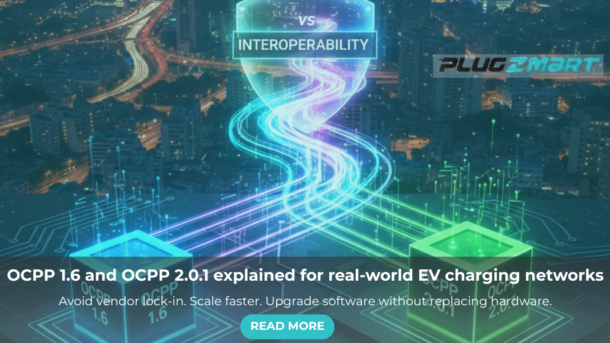
If you have spent any time around EV charging infrastructure, you have probably heard the term OCPP come up again and again. It sounds technical, but it shapes almost everything about how charging networks actually work. From whether a charger talks to your app to whether a CPO can switch software platforms, OCPP decides how flexible or locked-in your system becomes.
The conversation today often comes down to two versions: OCPP 1.6 and OCPP 2.0.1. Both matters. Both are widely discussed. And both play different roles in where the industry is heading.
Let us break this down without jargon.
What OCPP Is Really About
At its core, OCPP is a communication language. It allows an EV charger to talk to a backend system, usually an EV charging CMS. That backend handles user authentication, billing, monitoring, diagnostics, and updates.
Here is the thing. When chargers and software speak the same open language, operators are not tied to one vendor forever. They can change software, expand networks, or integrate with roaming platforms without ripping out hardware.
That freedom is what interoperability means in practice.
Why OCPP 1.6 Became the Industry Workhorse
OCPP 1.6 is the most widely deployed version in India today. Most public chargers, home chargers, and commercial installations use it. There is a good reason for that.
OCPP 1.6 is stable.
It supports core charging functions well.
It works reliably across AC and DC chargers.
It integrates smoothly with most EV charging CMS platforms.
For EV charger manufacturers in India, OCPP 1.6 offered a common foundation that allowed the ecosystem to scale quickly. Brands like Plugzmart and other EV charging station manufacturers in India adopted it early because it enabled compatibility with multiple software providers and CPO platforms.
If your goal is to deploy chargers today with proven reliability, OCPP 1.6 still does its job well.
Where OCPP 2.0.1 Changes the Conversation
OCPP 2.0.1 is not just a version update. It reflects how the charging ecosystem is maturing.
This newer protocol was designed with advanced use cases in mind. Things like:
• better security and encryption
• deeper device management
• improved transaction handling
• support for smart charging at scale
• readiness for future vehicle-to-grid scenarios
What this really means is that OCPP 2.0.1 treats chargers less like simple endpoints and more like intelligent network devices.
For large CPOs, fleet operators, and utilities planning long-term infrastructure, this matters. As networks grow, visibility and control become more important than basic connectivity.
So, Which One Should You Choose
This is where many people get confused. The answer is not one-size-fits-all.
If you are deploying chargers today for residential projects, malls, offices, hotels, or highways, OCPP 1.6 remains a solid choice. It is widely supported, well understood, and compatible with most EV charging CMS platforms in the market.
If you are planning a large-scale rollout with long-term flexibility in mind, especially one that involves advanced grid interaction or complex fleet management, OCPP 2.0.1 starts to make sense.
Many EV charger manufacturers in India are now designing hardware that can support both, either through upgrades or modular software layers. Plugzmart follows this approach by building chargers and CMS platforms that prioritise interoperability rather than locking operators into a single ecosystem.
Why Interoperability Matters More Than Version Numbers
It is easy to debate protocol versions. But the bigger issue is whether your charging infrastructure is open or closed.
Closed systems trap operators.
Open systems give choice.
Interoperability allows:
• Switching CMS providers without replacing chargers
• Integrating with roaming platforms
• Onboarding new CPO partners
• Scaling across cities and states
• Future-proofing against regulation changes
This is especially important in India, where policies, tariffs, and platforms are still evolving. EV charging station manufacturers in India that focus on open standards give operators room to adapt instead of forcing upgrades every few years.
The Indian Context Makes Interoperability Essential
India’s EV market is growing fast, but it is not uniform. Different states move at different speeds. Different utilities follow different rules. Different CPOs use different software stacks.
In this environment, interoperability is not a nice-to-have. It’s essential.
Chargers that support open OCPP standards integrate more easily with state platforms, private EMSPs, and enterprise systems. They also survive policy shifts better because the backend can evolve without touching the hardware.
This is why Plugzmart and other EV charger manufacturers in Chennai focus on open protocol support and OCPP API readiness. It reduces friction for everyone involved.
What the Future Looks Like
OCPP 1.6 will continue to power a large part of India’s charging network for years. OCPP 2.0.1 will slowly gain ground as networks become more complex and software-driven.
But the real future is not about choosing one over the other. It is about building systems that stay open, upgradeable, and interoperable.
What this really means is simple.
Chargers should never limit your business choices.
Protocols should enable growth, not block it.
If you are selecting chargers today, ask one question above all else. Can this charger work with multiple CMS platforms tomorrow? If the answer is yes, you are already thinking ahead.
FAQS
What is OCPP and why is it important?
OCPP (Open Charge Point Protocol) is the communication standard that allows EV chargers to connect with a Charging Management System (CMS). It enables functions like authentication, billing, monitoring, diagnostics, and remote updates. Open OCPP ensures chargers are not locked to a single software provider.
Is OCPP mandatory for EV chargers in India?
While OCPP is not legally mandatory in all cases, it is the industry-accepted standard for public and commercial EV charging infrastructure in India. Most CPOs, utilities, and EMSPs prefer OCPP-compliant chargers for interoperability and scalability.
What does interoperability mean in EV charging?
Interoperability means EV chargers can work with multiple CMS platforms, roaming networks, and backend systems. It allows operators to switch software providers, integrate new partners, and scale networks without vendor lock-in.