Ask any EV user what frustrates them the most, and the answer is usually the same. A charger that looks available but does not work. Downtime is the silent killer of EV charging networks. It hurts user trust, kills revenue, and turns a good location into a wasted asset.
This is where real-time monitoring through a smart charging management system changes everything.
Let us break down how a CMS reduces charger downtime and why it matters more than adding more chargers.
Downtime Is Rarely Sudden. It Builds Quietly
Here is the thing. Most charger failures do not happen out of nowhere.
They start small.
A voltage fluctuation here.
A connector heating up there.
A communication drop that fixes itself and then comes back.
Without monitoring, these issues stay invisible until a user complains. By then, the charger may already be unusable for hours or days.
Real-time monitoring flips this equation. It turns invisible problems into early warnings.
What Real-Time Monitoring Really Means
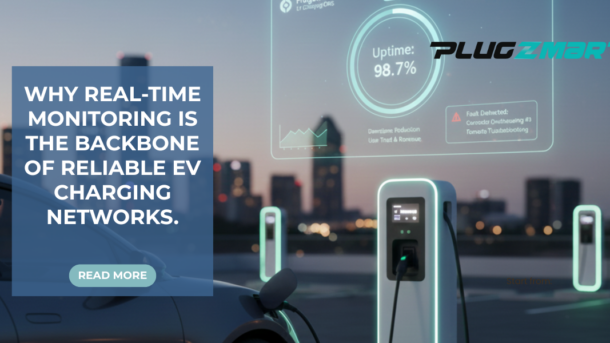
Real-time monitoring is not just a dashboard showing green and red dots. A proper EV Charging CMS continuously tracks the health of every charger in the network.
It monitors:
- Charger availability and session status
- Power draw and voltage stability
- Connector temperature and fault codes
- Communication status between charger and backend
- Failed sessions and aborted transactions
When something looks off, the system flags it immediately.
For operators using platforms from EV Charger Manufacturers in India like Plugzmart, this visibility is built into the system from day one.
How a CMS Cuts Downtime by 80 Percent
The reduction in downtime does not come from magic. It comes from speed.
Let us break it down.
First, faults are detected instantly.
Instead of waiting for a user call, the CMS sends alerts the moment performance drops.
Second, issues are diagnosed remotely.
Many faults can be resolved through a reboot, parameter reset, or firmware update. No site visit needed.
Third, maintenance becomes predictive.
If a connector repeatedly overheats or a charger trip at certain loads, the system highlights the pattern before failure.
Fourth, support teams act with context.
When a technician is dispatched, they already know the issue. This cuts repair time dramatically.
This combination easily reduces downtime by 70 to 80 percent compared to reactive maintenance.
Why Hardware Alone Is Not Enough
A well-built charger is important, but hardware without monitoring is blind. Even the best AC charger or DC Fast Charger for EV in India will fail occasionally if it operates long hours in heat, dust, and unstable grids.
This is why leading EV Charging Station Manufacturers in India design chargers and CMS together. Plugzmart follows this approach by tightly integrating its hardware with a CMS that supports real-time diagnostics and OCPP API communication.
The result is not just fewer failures. It is faster recovery when failures do occur.
Real-Time Monitoring Improves User Trust
EV users remember bad charging experiences more than good ones.
One failed session can discourage repeat use.
When a CMS keeps uptime high, users experience:
- Fewer failed starts
- Accurate availability on apps
- Predictable charging sessions
- Faster issue resolution
Over time, this builds trust. And trust is what drives utilisation.
High uptime leads to higher sessions. Higher sessions lead to better returns for CPOs and property owners.
The Business Impact of Reduced Downtime
For operators, downtime is not just a technical issue. It is a revenue issue.
Every offline hour means:
- Lost charging sessions
- Lost customer confidence
- Negative app reviews
- Reduced footfall for host properties
With real-time monitoring, chargers stay online longer and earn more consistently. Many operators see utilisation increase without adding new chargers, simply by keeping existing ones healthy.
This is why CMS adoption is rising fast among EV Charger Manufacturers in Chennai and across India.
CMS Matters Even More for DC Fast Chargers
DC fast chargers run harder and face more stress than AC chargers. They handle higher currents, faster thermal cycles, and heavier usage. Without monitoring, failures escalate quickly.
A CMS allows operators to:
- Track thermal performance
- Balance load across connectors
- Detect partial failures before full shutdown
- Schedule preventive maintenance
For highways, fleets, and commercial hubs, this level of control is non-negotiable.
What This Really Means
The future of EV charging is not about installing more hardware and hoping it works. It is about keeping chargers online, reliable, and predictable. Real-time monitoring through a smart EV Charging CMS turns charging infrastructure from a reactive system into a proactive one.
When chargers are monitored properly, downtime drops sharply. User confidence rises. Revenue stabilises. And operators stop firefighting issues they could have prevented.
If you want EV chargers that stay online instead of waiting to be fixed, the CMS is no longer optional. It is the backbone of a reliable charging network.
FAQS
What is real-time monitoring in an EV Charging CMS?
Real-time monitoring continuously tracks the health, performance, and availability of each charger, helping operators detect issues before users are affected.
How does a CMS reduce charger downtime by up to 80%?
By instantly detecting faults, enabling remote fixes, predicting failures, and reducing on-site repair time through data-driven diagnostics.
3. Can charger issues be fixed remotely through a CMS?
Yes. Many common issues like communication errors, session failures, and software glitches can be resolved remotely without visiting the site.