India’s EV charging infrastructure is rapidly expanding with rising EV adoption. Success lies in smart load management, OCPP-enabled interoperability, and reliable systems—helping businesses build scalable, high-ROI, future-ready EV charging networks.
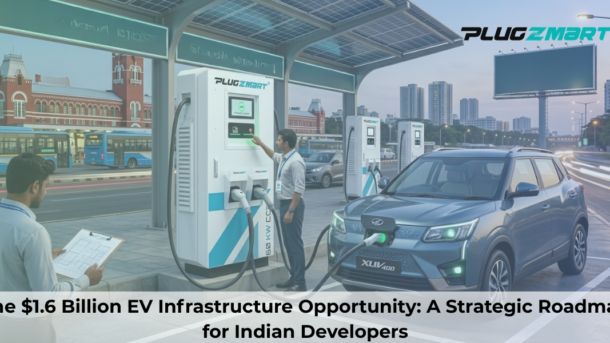
Indian EV Infrastructure is set to grow rapidly over the next decade with an estimated value of USD 1.6 billion by 2030—this is why it’s important for those operating in the Chennai & Tamil Nadu region to develop strategies that consider Smart Load Management, interoperability between systems, as well as dependability through the entire lifespan of the infrastructure to ensure their foresight pays off.
The Macro Perspective: Drivers of $1.6 Billion Growth
The move towards the goal of having 2.5 million+ charging units on our roads by the year 2030 is being fueled by what I like to call the “triple-threat” from three different sources of influence in the marketplace. First, there is the significant public policy support for electric vehicle charging infrastructure through government programs such as PM E-DRIVE and over $1.3 billion of allocated subsidies that greatly reduce the risk for private investment in the industry. There is a clear indication of an increase in the usage of fast-charging (DC technology) compared to Level 2 (AC technology). This indicates that as the frequency of DC Fast Charging has increased at commercial centers (such as along highways), there is a continued growth in driving for the purpose of maximizing returns per charger by being able to charge cars quickly. Finally, as we see more logistics companies electrifying their fleets and ride-hailing services (e.g., Uber, Lyft) adopting electric vehicles, we are strategically positioning ourselves to develop a “predictable” demand for charging stations. This means that charging stations will be consistently used and have higher levels of utilization than they do today.
Bridging the Gap: Real-World Implementation Challenges
The macro numbers are great but the deployment reality is quite complicated. In large-scale residential projects such as the 450+ unit development in Puzhal there are a lot of hurdles to implementing the chargers; the biggest impediment to this rollout is not the charger but rather the Grid Infrastructure. Developers think that a common local grid can power multiple high capacity chargers simultaneously, but in truth, the economic implementSmall Load Management System to meet the demand for every vehicle to be fully charged prior to the morning without having to spend on transformers.
The industry also faces the interoperability trap; any chargers that only work with a particular brand of vehicle are ‘stranded assets’. To achieve long-term value from your investment in charging hardware, you must utilize open charge point protocols (OCPP) on your hardware, as this will allow your hardware to communicate with all charging management systems (CMS), thereby protecting your investment from vendor lock and allowing future upgrades to the system software. In addition to protecting your return on investment, it is important to focus on reliability over quantity; with the threat of dust and voltage fluctuation in the Indian climate, it is essential for you to use ARAI-certified hardware with a remote diagnostics system to ensure that your system provides at least 99.9% uptime, which is what your commercial B2B clients expect.
Using Technology to Differentiate Yourself: Smart Technology vs Hardware
EV chargers today consist of approximately 40% hardware, 60% smart. To compete successfully in a multi-billion dollar industry, you need to have Infrastructure that uses Real-Time Monitoring and Load Balancing to manage energy consumption and reduce peak demand costs paid to utility companies. Also, Predictive Maintenance, by using mobile applications, allows you to fix issues before a user reports them through remote analysis. This technology is what turns your regular electrical outlet into a high-performing, cost-generating asset for your business.
Conclusion – Implementation of Strategy To Achieve High Growth
The opportunity for first mover advantage in India’s Electric Vehicle marketplace remains viable but decreasing rapidly with increasing competition. The residential focus is to develop EV ready parking to both enhance property value as well as provide convenience for residents. In the commercial and mall environments, DC Fast chargers are contributing to driving high-quality foot traffic (more time spent by users) and in fleet depots the focus should be on improving operational efficiency in order to have high utilisation levels.
By focusing on quality of equipment, interoperability of equipment, and smart management solutions now, developers can ensure that their infrastructure is relevant, and profitable through 2030 and further. Transitioning to a more sustainable mobility option requires cooperation and collaboration between entities. Those developers who create solid, intelligent, and integrated networks today will control the “gas stations” of tomorrow.