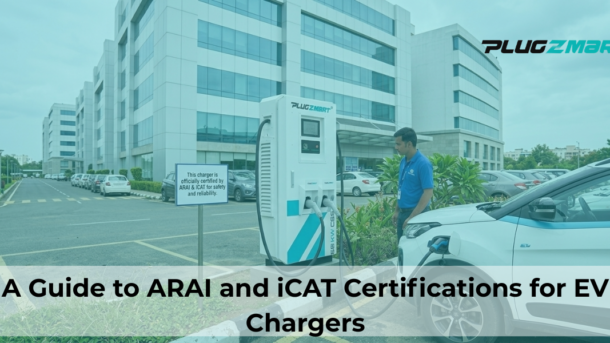
If you are dealing with EV chargers in India, you have probably heard these two names repeatedly: ARAI and iCAT.
For some people, they are just compliance checkboxes. For others, they are confusing acronyms buried inside tender documents. But here is the truth. If you are manufacturing, installing, or investing in EV charging infrastructure in India, understanding these certifications is not optional.
Let us break it down clearly.
Why Certification Matters for EV Chargers
An EV charger is not just a power outlet. It handles high voltage, communicates with vehicles, interacts with the grid, and in many cases processes payments.
That means it must be:
- Electrically safe
- Technically reliable
- Environmentally durable
- Compatible with Indian grid conditions
- Approved for public deployment
Without proper certification, chargers may face rejection in government projects, large commercial developments, or public tenders. More importantly, uncertified hardware increases safety and reliability risks.
This is where ARAI and iCAT come in.
What Is ARAI Certification?
ARAI stands for the Automotive Research Association of India. It is one of the key government-recognized testing and certification bodies for automotive and EV-related equipment.
When an EV charger is ARAI certified, it means:
- The charger has undergone rigorous electrical safety testing
- It complies with relevant Indian and international standards
- It meets performance and durability benchmarks
- It has been evaluated for safe integration with EV systems
ARAI testing typically includes:
- Protection against electric shock
- Short-circuit and overload protection validation
- Environmental testing for temperature and humidity
- Connector and communication protocol verification
For many state tenders and public infrastructure projects, ARAI approval is mandatory.
What Is iCAT Certification?
iCAT stands for the International Centre for Automotive Technology. Like ARAI, it is a government-recognized automotive testing and certification authority in India.
iCAT performs:
- Electrical and mechanical testing
- Performance validation
- Compliance verification with Indian EV standards
- Homologation and regulatory approvals
For EV chargers, iCAT certification ensures that the product meets required safety, interoperability, and performance standards before deployment.
In many cases, manufacturers may choose either ARAI or iCAT depending on project requirements and compliance pathways.
ARAI vs iCAT: What is the Difference?
From a regulatory standpoint, both are approved certification agencies. The difference is less about quality and more about process and specialization.
ARAI is often associated strongly with automotive homologation and vehicle-related systems.
iCAT is widely involved in automotive testing and certification across components and systems.
For EV charger manufacturers, what matters most is:
- The charger meets national standards
- The certification is recognized by authorities
- The documentation is complete for tenders and large deployments
In short, both serve similar compliance purposes. What matters is that certification is genuine and verifiable.
Which Chargers Need Certification?
In India, the following typically require certification:
- Public AC chargers
- Public DC fast chargers
- Fleet charging stations
- Commercial charging installations
- Chargers deployed in government projects
Even private installations, such as in gated communities or office complexes, increasingly demand certified equipment to ensure safety and liability protection.
For high-power DC fast chargers especially, certification becomes critical because of higher current, grid impact, and thermal management risks.
Why Buyers and Developers Should Care
If you are a builder, fleet operator, mall owner, or charging point operator, certification protects you.
Here is what it ensures:
- Lower risk of electrical hazards
- Compliance with state EV mandates
- Eligibility for subsidies and incentives
- Protection against legal and insurance complications
- Long-term reliability
Installing uncertified chargers might save cost upfront, but it introduces long-term operational risk.
How Certification Impacts Manufacturers
For EV charger manufacturers, ARAI or iCAT certification signals seriousness.
It allows them to:
- Participate in government tenders
- Supply to large enterprises
- Build trust with commercial developers
- Expand into regulated markets
- Compete with established players
Certification is not just technical validation. It is a market access tool.
The Hidden Layer: Software and Compliance
Modern chargers are not just hardware. They run firmware and connect to charging management systems.
While ARAI and iCAT focus heavily on hardware safety and performance, forward-looking deployments also evaluate:
- OCPP compliance
- Communication security
- Firmware reliability
- Data integrity
Certification is the foundation. Software reliability builds on top of it.
Final Thoughts
ARAI and iCAT certifications are not just bureaucratic hurdles. They are safeguards for an industry that deals with high power, public safety, and critical infrastructure.
If you are manufacturing EV chargers, certification is your entry ticket to serious projects.
If you are buying or deploying chargers, certification is your risk management layer.
As India’s EV ecosystem grows, compliance will only become stricter. Understanding ARAI and iCAT today helps you avoid costly mistakes tomorrow.
FAQs
Are these certifications mandatory in India? Yes, for all public and government-funded
charging projects. While private home chargers have more flexibility, commercial deployment requires them for safety and grid compliance.
What is the main difference between ARAI and iCAT?
Both are government-authorized testing bodies. The primary difference is location and lab availability: ARAI is based in Pune, while iCAT is in Manesar (Gurugram). Their certifications hold equal weight.
Does certification help with subsidies?
Absolutely. To qualify for FAME-II subsidies or state-level incentives, the EV charger must be certified by either ARAI or iCAT.