If you have ever tried to scale EV charging at an apartment, office park, depot, or commercial site, you have hit the same wall. The grid connection becomes the bottleneck long before demand does.
You have parking.
You have EVs.
You do not have unlimited power.
This is where dynamic load balancing stops being a nice feature and becomes the only way forward.
Let us break down how it works and why it is the reason 20 EVs can charge reliably on a single grid connection.
The Traditional Problem With Fixed Power Allocation
Most early charging setups follow a simple rule.
One charger equals one fixed power allocation.
If you install:
- Ten 7.4 kW chargers
- You assume 74 kW of available load
That assumption forces upgrades. Higher sanctioned load. New transformers. Higher demand charges. Long approval cycles.
Here is the thing. In real life, EVs do not charge at full power all the time. Some finish early. Some arrive later. Some taper down as batteries fill up. Fixed allocation wastes capacity.
Dynamic load balancing exists to fix that mismatch.
What Dynamic Load Balancing Actually Does
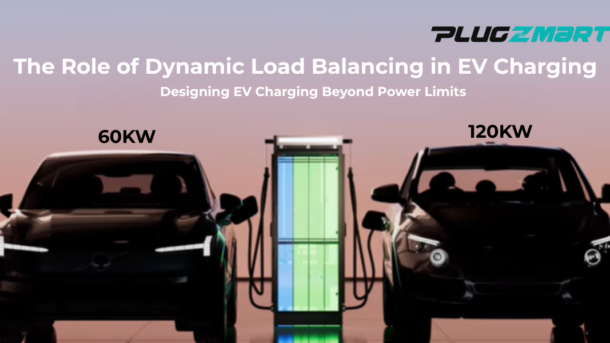
Dynamic load balancing is a software-driven system that continuously adjusts how much power each charger receives based on real-time conditions.
Instead of assigning fixed power to every charger, the system looks at:
- total available grid capacity
- number of connected vehicles
- charging state of each vehicle
- priority rules set by the operator
- time-of-day constraints
Power is then distributed intelligently across all active chargers.
No overloads. No manual intervention.
How 20 EVs Can Share One Connection
Let us take a practical example.
You have a site with:
- a 100-kW sanctioned grid connection
- 20 AC chargers installed
Without load balancing, this would be impossible.
With dynamic load balancing, it becomes manageable.
Here is how it plays out:
- 5 EVs arrive first and draw higher power
- Another 10 arrive later and share the remaining capacity
- Some vehicles slow down as they near full charge
- Power is reallocated automatically to vehicles that need it more
At any moment, the total draw never exceeds 100 kW.
Yet all 20 EVs continue charging.
Nobody trips breakers. Nobody waits unnecessarily.
Why This Works in the Real World
The key insight is diversity of demand.
Not every EV need:
- Maximum power
- At the same time
- For the same duration
Dynamic load balancing takes advantage of this natural variation.
It works especially well in:
- Apartment parking where vehicles stay overnight
- Office campuses where arrivals are staggered
- Fleet depots with predictable schedules
- Hotels and malls with mixed dwell times
The longer vehicles stay plugged in, the more effective load balancing becomes.
The Role of Software and CMS
Dynamic load balancing is not just a hardware feature. It depends heavily on the charging management system.
A good CMS:
- Monitors real-time power usage
- Enforces site-level load limits
- Communicates with chargers instantly
- Adjusts allocation every few seconds
- Logs behaviour for optimization
Without software intelligence, chargers cannot coordinate. They behave independently and overload the system.
This is why modern EV charging networks treat load balancing as a core software capability, not an add-on.
Benefits Beyond Avoiding Grid Upgrades
Most people think load balancing is only about avoiding electrical upgrades. That is only half the story.
It also enables:
- Lower capital costs
- Faster project approvals
- Simpler electrical design
- Higher charger density per site
- Better user experience during peak hours
In many cases, it is the difference between installing 6 chargers and installing 20.
What This Means for Scaling EV Charging
As EV adoption rises, grid capacity will always lag behind demand. Waiting for unlimited power is not realistic.
Dynamic load balancing allows charging networks to scale intelligently within existing constraints. It makes better use of the power already available instead of constantly asking for more.
What this really means is simple.
EV charging does not need infinite electricity.
It needs smarter distribution.
If you want charging to scale without breaking the grid, dynamic load balancing is not optional. It is the foundation.
FAQS
Is dynamic load balancing required for all EV charging sites?
It is not mandatory, but it becomes essential as soon as multiple chargers share a limited grid connection. Any apartment, office, fleet depot, or commercial site installing more than a few chargers will benefit significantly.
2. Does dynamic load balancing slow down charging?
No. It optimizes charging. Vehicles still charge reliably, and power is redistributed intelligently so no charger is idle while others are overloaded.
Can dynamic load balancing work with existing chargers?
Yes, if the chargers support smart communication protocols like OCPP and are connected to a compatible Charging Management System (CMS).