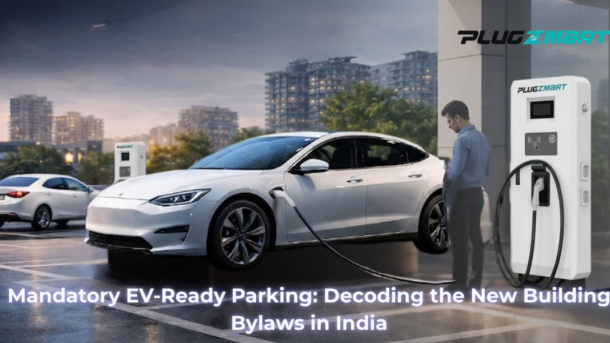
India’s 2026 bylaws mandate EV-ready parking in new builds. Compliance (20% slots minimum) is now tied to Occupancy Certificates. It’s a core utility, not a luxury.
Electric vehicles are moving from early adoption to mainstream infrastructure planning. That shift has forced building regulations to evolve. Charging access is no longer treated as an optional amenity or a future upgrade. It is now part of core building compliance in many Indian cities.
Across the country, urban development authorities are updating building bylaws to require dedicated EV-ready parking spaces in new construction projects. These rules apply to residential complexes, commercial buildings, malls, offices, and institutional facilities. In several states, occupancy certificates depend on meeting these requirements.
For developers, facility managers, and charging network operators, understanding these bylaws has become a design and business priority.
EV-Ready Parking Is Becoming a Standard Requirement
The push toward EV-ready parking began at the national level through revisions to the Model Building Bye-Laws issued by the Ministry of Housing and Urban Affairs. These guidelines introduced a clear baseline requirement for charging infrastructure in new buildings.
Most states now follow a similar structure:
- A portion of parking capacity must be reserved for EV charging
- Electrical infrastructure must be planned during construction
- Power load calculations must account for future charging demand
In many jurisdictions, at least 20% of parking spaces in new buildings must be prepared for EV charging infrastructure, including wiring and electrical capacity.
This requirement reflects a shift in planning philosophy. Charging infrastructure is expected to be built into the design stage rather than added later through retrofits.
State-Level Rules Are Getting More Specific
While national guidelines set the direction, state governments are introducing more detailed mandates based on local demand and infrastructure planning.
Example: Tamil Nadu
Recent amendments to building rules in Tamil Nadu illustrate how quickly requirements are evolving.
Key provisions include:
- Every required car parking slot must support EV charging
- Two-wheeler parking must also include charging provisions
- Large residential complexes must provide fast charging in visitor parking areas
- Commercial buildings must allocate charging in at least 10% of parking spaces
These rules apply to most new developments and aim to ensure charging access is available for residents, visitors, and service vehicles.
Smaller buildings with limited height or unit count may be exempt, but most urban projects fall within the scope of the mandate.
What “EV-Ready” Actually Means in Practice
The term EV-ready does not simply refer to installing chargers. It refers to preparing infrastructure so chargers can be deployed quickly without major electrical modifications.
Typical EV-ready requirements include:
- Dedicated electrical conduits and wiring pathways
- Load capacity planning in the building transformer
- Space allocation for distribution panels
- Safety compliance with electrical standards
These provisions allow charging stations to be installed when demand grows, without tearing up parking areas or upgrading the entire electrical system.
In technical terms, the building is designed to support charging rather than reacting to it.
Why Governments Are Mandating EV-Ready Parking
The policy shift is driven by operational realities rather than long-term projections.
A large majority of EV charging happens at home or at the workplace. When buildings lack charging infrastructure, adoption slows because users cannot rely on convenient daily charging access.
Urban planning authorities have recognized this dependency.
Recent policy updates focus on three objectives:
Supporting Daily Charging Access
Residential charging remains the most reliable way to keep EVs operational. Without home charging, drivers depend heavily on public infrastructure, which increases congestion and waiting times.
Avoiding Expensive Retrofits
Retrofitting electrical infrastructure after construction can be expensive and disruptive. Planning charging capacity during the design phase reduces long-term costs and improves reliability.
Preparing for Rapid EV Growth
EV adoption is accelerating across passenger vehicles, delivery fleets, and ride-hailing services. Buildings designed today must remain functional for decades, and infrastructure planning needs to account for that growth.
Compliance Is Now Linked to Project Approvals
One of the most significant changes in recent bylaws is enforcement.
Charging readiness is no longer treated as a recommendation. It is increasingly tied to regulatory approvals.
In several states:
- Projects may not receive occupancy certificates without EV charging provisions
- Electrical load calculations must include charging demand
- Safety standards must be documented before commissioning
Some state policies explicitly state that new housing developments must include charging infrastructure as part of project approval requirements.
For developers, this shifts charging from a marketing feature to a compliance requirement.
Commercial Buildings Face Different Requirements
Commercial and institutional facilities often have higher parking turnover and more diverse vehicle usage patterns. As a result, their charging requirements typically differ from residential buildings.
Common commercial rules include:
- A defined percentage of parking must support EV charging
- Fast chargers must be available in visitor or public parking zones
- Charging access must operate continuously
For example, large commercial buildings in some regions must provide charging facilities in at least 10% of parking spaces, often with fast-charging capability.
These provisions recognize the role of commercial properties as public charging hubs.
Fire and Safety Guidelines Are Also Evolving
As charging infrastructure expands, safety standards are becoming more detailed.
Recent fire safety guidance addresses installation locations, ventilation requirements, and emergency procedures.
For instance:
- Charging stations may be restricted in certain automated parking structures
- Safety systems must comply with electrical and fire regulations
- Installations must follow approved equipment standards
These rules aim to ensure that charging infrastructure remains safe as deployment scales across residential and commercial environments.
What This Means for Developers and Property Owners
Mandatory EV-ready parking is changing how buildings are designed, financed, and operated.
Developers now need to consider:
- Electrical capacity planning during design
- Charger placement within parking layouts
- Future expansion of charging infrastructure
- Compliance documentation for approvals
Property owners and facility managers face a different set of responsibilities.
They need to manage:
- Charging access policies
- Maintenance of electrical systems
- Coordination with charging service providers
- Energy consumption monitoring
These operational requirements are becoming part of routine building management.
The Bigger Shift: Charging Infrastructure Is Becoming Core Utility Infrastructure
Electric vehicle charging is moving into the same category as elevators, fire safety systems, and backup power. It is no longer an optional upgrade or a premium feature.
Urban infrastructure planning now assumes that:
- Vehicles will require daily charging access
- Buildings must support that demand
- Electrical systems must be designed for long-term growth
Mandatory EV-ready parking rules reflect this new baseline.
Buildings constructed today are expected to function in a transport system where electric mobility is standard rather than emerging.
FAQS
What is EV-ready parking?
EV-ready parking means parking spaces are pre-equipped with electrical infrastructure like wiring, conduits, and load capacity to support future EV charger installation.
Is EV-ready parking mandatory in India?
Yes, many states have made EV-ready parking mandatory for new buildings, with requirements often linked to project approvals and occupancy certificates.
How much parking must be EV-ready?
Typically, at least 20% of parking spaces must be EV-ready, though some states like Tamil Nadu require a higher percentage depending on building type.