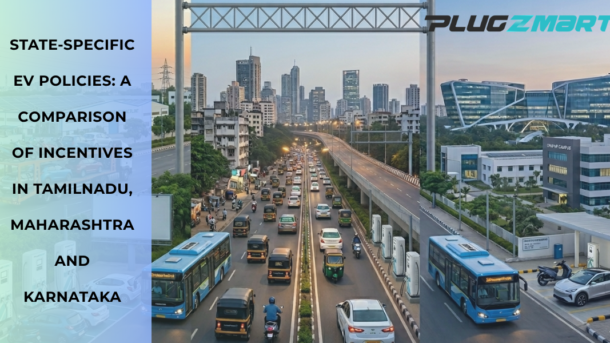
Tamil Nadu leads in EV manufacturing with industrial subsidies, while Maharashtra drives adoption through direct consumer incentives and toll waivers. Karnataka serves as a tech hub for R&D and ultra-fast charging. Success depends on aligning business goals with these state-specific pillars.
Electric vehicle adoption in India is shaped as much by state policy as by technology or vehicle availability. While national programs such as FAME provide a baseline level of support, state governments determine how quickly charging infrastructure expands, how affordable EV ownership becomes, and where manufacturing investments are directed. These policies influence decisions made by fleet operators, real estate developers, and charging network providers on a daily basis.
Tamil Nadu, Maharashtra, and Karnataka are often grouped together because they were among the early movers in electric mobility policy. Each state has developed a different strategy based on its industrial strengths, urban demand patterns, and infrastructure priorities. Understanding these differences helps businesses choose locations for deployment, estimate project costs, and anticipate long-term growth opportunities.
Tamil Nadu: Manufacturing-Led Growth and Infrastructure Expansion
Tamil Nadu’s EV policy focuses heavily on building an industrial ecosystem around electric mobility. The state positions itself as a manufacturing hub for vehicles, batteries, and charging equipment, supported by incentives that reduce capital costs for companies setting up production facilities.
One of the most notable features of the policy is support for manufacturing investments. Companies establishing EV-related facilities in designated regions can receive subsidies on land acquisition and infrastructure development, which lowers the entry barrier for large-scale production. The policy also includes extended road tax exemptions for electric vehicles to encourage adoption. Tamil Nadu’s updated policy provides a 100% road tax waiver through the current policy period, helping accelerate vehicle registrations across the state. (exicom.com)
Infrastructure development is another priority. Urban centress such as Chennai and Coimbatore have seen steady growth in charging installations, supported by state programs that promote private investment in public charging networks. The emphasis is on building capacity early so that demand growth does not outpace infrastructure availability.
For businesses in the charging sector, Tamil Nadu offers a stable environment for manufacturing and deployment, particularly for companies planning long-term operations in southern India.
Maharashtra: Demand Incentives and Urban Charging Networks
Maharashtra’s EV policy focuses strongly on adoption and usage. The state has introduced direct financial incentives that reduce the cost of owning and operating electric vehicles, while also supporting the expansion of public charging infrastructure in dense urban areas.
The policy provides purchase subsidies for electric vehicles across multiple categories, with incentives reaching significant amounts depending on battery size and vehicle type. In addition to these subsidies, the state offers full exemptions on road tax and registration fees, which significantly lowers upfront costs for buyers. (BankBazaar)
Another distinctive element is support for charging infrastructure development. Maharashtra encourages public-private partnerships to build charging stations along highways and within city centers, particularly in Mumbai and Pune. These programs aim to create reliable charging corridors that support both private vehicles and commercial fleets. (DIYguru)
Recent policy actions also include toll exemptions for electric vehicles on major expressways, further reducing operating costs and encouraging long-distance EV travel. (The Times of India)
For charging businesses and fleet operators, Maharashtra offers a strong demand-driven environment where infrastructure utilization tends to grow quickly once deployment begins.
Karnataka: Innovation and Technology Development
Karnataka was one of the first states in India to introduce a dedicated EV policy, and its strategy continues to focus on technology development and startup innovation. The state has positioned itself as a testing ground for new charging technologies, supported by a strong ecosystem of research institutions and mobility startups.
The policy promotes private investment in charging infrastructure and encourages the development of advanced technologies such as ultra-fast charging systems. Bengaluru, in particular, has become a hub for pilot projects involving high-speed charging and energy management solutions. (DIYguru)
Financial incentives in Karnataka include tax exemptions and support for manufacturing and component production. The state has also introduced investment incentives for companies building EV-related facilities, including charging equipment and battery systems. These measures aim to attract large-scale investments and strengthen the local supply chain. (Reuters)
Karnataka’s approach emphasizes innovation and experimentation, making it attractive for companies developing new products or business models in the charging sector.
Key Differences in Policy Priorities
Although all three states aim to accelerate electric mobility, their policies reflect different priorities.
Tamil Nadu focuses on manufacturing capacity and long-term industrial development.
Maharashtra emphasizes adoption incentives and large-scale infrastructure deployment.
Karnataka prioritizes innovation and technology experimentation.
These differences influence how quickly charging networks expand, how much capital is required for deployment, and how stable long-term demand is likely to be in each region.
What This Means for Charging Businesses and Infrastructure Developers
Choosing the right state for deployment involves more than comparing subsidies. Businesses must consider demand density, regulatory support, and long-term infrastructure planning.
For example, a company planning to manufacture charging hardware may find Tamil Nadu more attractive due to its industrial incentives and supply chain support. A network operator targeting high utilization rates may prefer Maharashtra because of its strong urban demand and financial incentives for vehicle adoption. A technology-focused startup developing advanced charging systems may benefit from Karnataka’s research-driven ecosystem.
These decisions affect capital investment, operating costs, and revenue potential over the lifetime of a charging project.
The Broader Policy Direction
State-level EV policies continue to evolve as adoption increases and infrastructure requirements become more complex. Governments are refining incentives to balance immediate adoption with long-term sustainability, while also encouraging private investment in charging networks and manufacturing facilities.
Tamil Nadu, Maharashtra, and Karnataka remain central to this transition. Their policies influence how quickly electric mobility expands across India and how efficiently charging infrastructure keeps pace with demand. Businesses that understand these policy differences can plan deployments more effectively and respond to market changes with greater confidence.
FAQS
Which state is best for setting up an EV manufacturing unit?
Tamil Nadu. Its policy is specifically geared toward industrial growth, offering heavy incentives for land acquisition and infrastructure development to build a robust manufacturing ecosystem.
Where is the best market for rapid charging station utilization?
Maharashtra. Due to aggressive purchase subsidies and road tax exemptions, vehicle adoption is high. This demand, combined with highway toll exemptions, ensures high turnover for charging networks in urban hubs like Mumbai and Pune.
Which state should a tech startup choose for piloting new charging software?
Karnataka. As an early mover with a focus on innovation, Karnataka (specifically Bengaluru) serves as a primary testing ground for ultra-fast charging and advanced energy management technologies.