The software layer behind an EV charger rarely gets as much attention as the hardware itself. Yet once a charger becomes part of a public, private, or fleet charging network, the backend determines how that charger communicates, how its status is monitored, how sessions are handled, and how easily it can work with other networks.
Most charging networks are built around a fairly direct relationship between the charger and its Charging Management System (CMS). The charger communicates with the CMS through OCPP, while the CMS takes care of monitoring, sessions, tariffs, billing, alerts, and other network operations.
The limitation appears when a charger needs to work with more than one CMS.
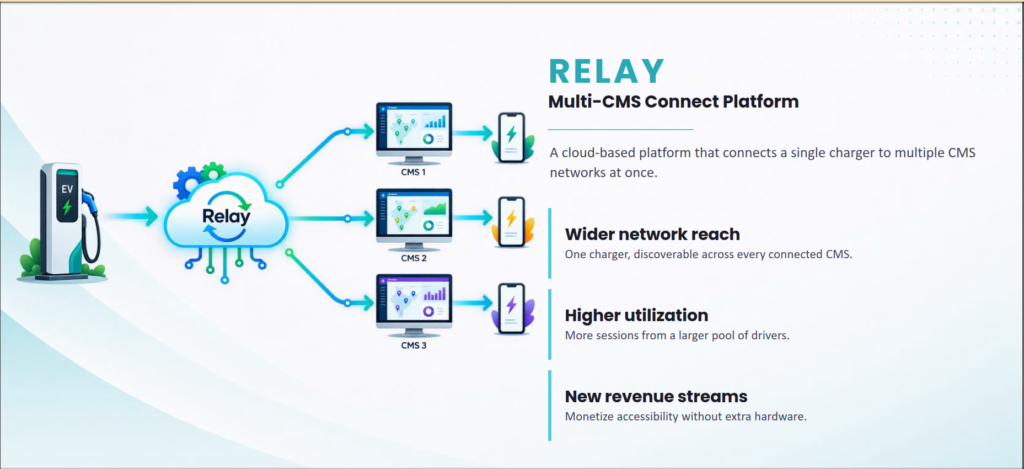
Plugzmart’s Relay was developed around this particular layer of the EV charging stack. It is a cloud-based multi-CMS platform that allows a single OCPP-compliant charger to connect with multiple CMS platforms simultaneously. The idea is relatively straightforward, but the architecture behind it has implications for how charging networks can be connected and operated as they expand.
The Charger and the CMS
An EV charger does not operate as an isolated piece of electrical equipment once it is connected to a charging network. It continuously exchanges information with a backend system. Availability, charging status, faults, sessions and other operational information need to move between the charger and the CMS, while the CMS may send commands back to the charger.
OCPP provides the communication standard for this relationship. Plugzmart’s charging platform supports OCPP 1.6 and OCPP 2.0.1 compliant chargers and CMS providers.
The conventional architecture is therefore fairly simple:
Charger → CMS
A charger is connected to a backend, and that backend becomes the primary software environment through which the charger is managed.
That works well when the charger only needs to operate within one network. The architecture becomes more restrictive when the same physical charger needs to be accessible through several CMS platforms or charging networks.
This is the gap Relay is designed to address.
Where Relay Sits in the Architecture
Relay introduces a cloud-based middleware layer between the charger and the CMS platforms.
Instead of establishing a direct one-to-one relationship between a charger and one CMS, the architecture allows the charger to communicate through Relay with multiple CMS platforms:
Charger → Relay → Multiple CMS platforms
The significance of this arrangement is not simply the number of connections. It separates the charger’s communication layer from dependence on a single backend.
Relay works at the charger-to-CMS layer, using OCPP-based communication to connect the charger with different CMS environments. This gives charger owners and operators more flexibility when they want to work with multiple networks without changing the underlying charger hardware.
The result is a one-to-many architecture in place of the more common one-to-one model.
OCPP as the Communication Layer
OCPP is central to this architecture because it provides a standard way for charging stations and backend systems to communicate.
A CMS can use OCPP to receive charger information and manage functions related to charging sessions and station operation. Since Relay operates around this communication layer, it can sit between the charger and multiple CMS platforms without requiring a proprietary communication method for each connection.
This is where the distinction between OCPP, OCPI and Relay becomes useful.
OCPP primarily deals with communication between the charging station and its backend. OCPI operates at the network level, supporting communication and roaming between different charging networks or CMS. Relay addresses another part of the stack by allowing one charger to establish connections with multiple CMS platforms.
Once those CMS platforms are connected to their respective roaming ecosystems, the reach of the charger can extend further. Plugzmart describes this relationship as a path from one charger to multiple CMS platforms and, through those networks, potentially to a wider pool of EV drivers.
What the Cloud Layer Adds
Putting Relay in the cloud provides a central place to maintain these CMS connections and observe what is happening across them.
This becomes increasingly relevant as the number of chargers and network relationships grows. A charging operator may have to deal with different CMS providers, different network requirements, and different sources of operational information. Keeping those relationships entirely at the individual charger level can make the architecture harder to manage.
A cloud-based middleware layer creates a common point for these connections.
Relay also provides visibility into CMS performance and charger health from a single platform. Operators can compare charger utilization across connected CMS platforms and examine information such as uptime and disconnection trends.
That monitoring layer is important because multi-CMS connectivity introduces more than just additional network access. It also creates more operational information that needs to be understood.
Looking at Charger Health Across Networks
A charger can be physically operational while still experiencing connectivity problems at the software layer. For an operator, distinguishing between charger faults, communication problems, and CMS-level issues becomes important when managing a larger charging network.
Relay’s monitoring capabilities bring charger health information into the same environment as CMS performance data. Uptime, disconnections and faults can be tracked alongside utilization information, giving operators a broader view of how their charging assets are performing.
This is particularly relevant for networks where chargers are exposed to multiple platforms. Instead of treating each CMS connection as a separate operational environment, the operator can examine the wider picture from the Relay platform.
The same principle applies to utilization. If a charger is available through more connected networks, it can become visible to a broader user base. Plugzmart positions this wider network reach as a way to improve charger utilization and create additional revenue opportunities.
Reducing Dependence on a Single CMS
Another consideration in a one-to-one charger architecture is dependency.
When a charger relies entirely on one CMS, an outage or connectivity problem at that platform can affect access to the charger even when the physical charging equipment is functioning normally.
Relay’s multi-CMS architecture is designed to reduce that dependency, when one connected CMS goes down, the other connected CMS platforms can continue operating without the same single-platform failure point.
For charging operators, this can matter more as the network grows. A short interruption at one software layer can affect charger availability, customer access and revenue, particularly at locations where utilization is already high.
Multi-CMS connectivity therefore has a reliability dimension in addition to its interoperability benefits.
Relay and the Wider Charging Software Stack
Relay is one layer within a larger EV charging software architecture.
The CMS still performs the core management functions required to operate charging infrastructure. It includes real-time charger monitoring, charger utilization dashboards, finance and revenue insights, tariff management, automated daily settlements, OCPP support, OTA firmware updates, alerts, role-based access control, charger-health monitoring, and session and invoice management.
Relay addresses a different requirement: how the charger communicates with multiple CMS environments.
This distinction matters when looking at EV charging management software. A CMS is responsible for managing the charging network itself, while a multi-CMS connectivity layer can provide another level of interoperability between the charger and different backend systems.
For CPOs, fleet operators, charger manufacturers and businesses managing charging infrastructure, the two can therefore serve complementary purposes.
Why Multi-CMS Architecture Matters
The charging industry is moving towards larger networks, more connected chargers and greater interaction between different service providers. As this happens, interoperability becomes increasingly relevant.
A charger that is technically capable of communicating through OCPP should not necessarily have to remain tied to one software environment for its entire operating life. A more flexible architecture allows the software ecosystem around the charger to evolve without requiring the physical infrastructure to change with every new integration.
That is the broader idea behind Relay.
By providing a cloud-based connection layer between an OCPP-compliant charger and multiple CMS platforms, Relay gives charger owners and operators another way to approach network connectivity. It can expand charger visibility across connected networks, provide a consolidated view of charger and CMS performance, and reduce dependence on a single CMS platform.
For an EV charging network, these are software decisions with very practical consequences. They influence how easily chargers can be connected, monitored, discovered and operated as the network grows.
Frequently Asked Questions
What is Plugzmart Relay?
Plugzmart Relay is a cloud-based multi-CMS platform that enables a single OCPP-compliant EV charger to connect with multiple CMS platforms simultaneously. It is designed to improve charger interoperability, network visibility and operational flexibility.
How does Relay connect a charger to multiple CMS platforms?
Relay operates as a middleware layer between the charger and connected CMS platforms. The charger communicates through OCPP, while Relay manages the connections with the different CMS environments.
Does Relay replace a CMS?
No. Relay and a CMS serve different roles. The CMS manages charging network operations, while Relay provides the connectivity layer that allows a charger to communicate with multiple CMS platforms.
Which OCPP versions does Plugzmart support?
Plugzmart’s platform supports OCPP 1.6 and OCPP 2.0.1 compliant chargers and CMS providers.
How can multi-CMS connectivity improve EV charger utilization?
A charger connected to multiple CMS platforms can become discoverable across a wider set of connected networks and apps. This can increase its potential user reach and create more opportunities for charging sessions.
What happens if one CMS goes offline?
Relay is designed so that other connected CMS platforms can continue operating if one CMS becomes unavailable, reducing reliance on a single backend connection.
Is Relay useful for CPOs?
Multi-CMS connectivity can be useful for CPOs that manage chargers across different networks or need greater flexibility in how their charging assets are connected and accessed.
What is the difference between OCPP, OCPI and Relay?
OCPP provides the communication protocol between chargers and backend systems. OCPI supports communication and roaming between charging networks. Relay operates as a middleware layer that connects an OCPP-compliant charger with multiple CMS platforms.