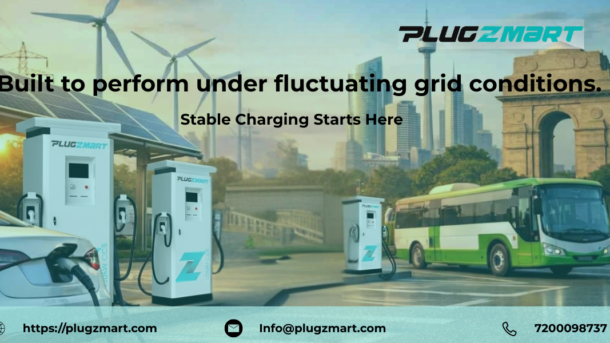
Made-in-India EV chargers are built for unstable grid conditions, handling voltage fluctuations with ease. They deliver higher uptime, fewer interruptions, and more reliable performance than imported chargers in real-world environments.
Electric vehicle charging in India operates under conditions that differ sharply from many global markets. Voltage variation, sudden load changes, and localized power instability are part of daily operations in several regions. These conditions place direct stress on charging equipment, particularly in commercial sites where uptime affects revenue and customer trust.
In this environment, hardware design decisions matter more than brand origin or specification sheets. Chargers built with Indian grid behavior in mind tend to maintain stable performance during fluctuations, while imported units designed for steadier power systems often struggle to adapt without additional protection systems.
Grid Fluctuations Are a Daily Operating Reality
Voltage swings, phase imbalance, and short-duration outages occur in both urban and semi-urban locations. Even modern commercial areas can experience transient disturbances during peak demand hours or infrastructure maintenance.
For charging operators, these disturbances show up as:
- Unexpected charger resets
- Session interruptions
- Communication drops between charger and CMS
- Component wear that shortens equipment life
Each incident may last only a few seconds, yet repeated exposure increases maintenance costs and reduces overall utilization.
Imported chargers are usually designed for grids with tighter voltage tolerance bands. When deployed in regions with wider variation, they rely heavily on external stabilizers, surge protection devices, or custom configuration to maintain consistent operation.
Hardware Designed for Local Power Conditions
Manufacturers building chargers specifically for India often start with a different assumption: the grid will vary, and the charger must handle that variation without external support.
This design philosophy shows up in several areas.
Wider Input Voltage Tolerance
Domestic chargers typically support broader operating ranges, allowing them to continue functioning during moderate voltage dips or spikes. This reduces shutdown events and keeps charging sessions active.
Enhanced Protection Circuits
Local designs frequently include layered protection against overvoltage, undervoltage, and phase irregularities. These protections are integrated into the core hardware rather than added as optional accessories.
Thermal and Electrical Margining
Components are selected with additional headroom to handle temperature rise and electrical stress. This approach improves reliability during long charging sessions in high-load conditions.
These adjustments are not complex features. They reflect an understanding of how infrastructure behaves in the field.
Firmware That Handles Real-World Variability
Hardware resilience alone does not guarantee stable performance. Software behavior during power disturbances plays an equally important role.
Chargers designed for Indian deployments often include firmware logic that prioritizes session continuity and safe recovery. Instead of shutting down immediately during minor voltage variation, the system can maintain operation within defined safety limits.
Common behaviors include:
- Gradual power ramp-down during voltage instability
- Automatic reconnection after brief outages
- Preservation of session data during interruptions
- Controlled restart sequences to prevent component stress
These routines reduce downtime and limit customer-facing disruptions.
Imported chargers may require firmware modification or configuration tuning to achieve similar behavior. Without those adjustments, the default response may be a full shutdown or communication reset.
Communication Stability During Power Events
Charging reliability depends on consistent communication between the charger and the management platform. Grid disturbances often interrupt this communication link before they affect the charging hardware itself.
Domestic designs frequently incorporate buffering and retry logic to maintain session state during temporary connectivity loss. This capability helps operators avoid billing errors and incomplete transaction records.
Stable communication becomes particularly important in networks using remote diagnostics and centralized control. Even short disruptions can trigger alarms, service calls, or manual intervention.
Reduced Dependence on External Protection Equipment
Imported units deployed in challenging grid environments often require additional hardware such as:
- Voltage stabilizers
- Surge protection panels
- Dedicated isolation transformers
- External monitoring systems
These additions increase installation cost and introduce more components that require maintenance.
Locally engineered chargers tend to integrate core protection mechanisms within the unit itself. Fewer external devices simplify site design and reduce potential failure points.
Over time, this difference shows up in operating expenses rather than purchase price.
Field Service and Spare Availability
Reliability depends not only on equipment performance but also on service response.
Manufacturers operating within the country typically maintain regional service teams and local spare inventories. Replacement components can reach a site within days rather than weeks.
Imported equipment may rely on international supply chains for specialized parts. When a component fails, downtime can extend while logistics and customs processes run their course.
For operators managing multiple charging stations, service turnaround time directly affects utilization and revenue.
Compliance With Local Standards and Certification
Domestic manufacturers design chargers to meet Indian electrical and safety requirements from the start. Testing and certification processes align with local regulations, grid characteristics, and installation practices.
Imported products often require adaptation to meet these same standards. In some cases, compliance testing identifies configuration changes or hardware adjustments that delay deployment.
Early alignment with local standards reduces commissioning time and lowers the risk of unexpected integration issues.
Long-Term Reliability in High-Load Environments
Charging stations in commercial settings operate for extended hours under continuous load. Temperature variation, dust exposure, and electrical stress combine to test equipment durability.
Design teams familiar with these conditions typically emphasize:
- Rugged enclosure construction
- Stable connector performance
- Consistent thermal management
- Resistance to environmental wear
These factors contribute to predictable uptime across multiple years of operation.
Why This Matters for Network Performance
Charging infrastructure generates value only when it remains available and functional. Frequent resets or shutdowns reduce session counts and erode user confidence.
Operators evaluating hardware options often focus on charging speed, connector type, and software features. Grid resilience deserves equal attention, particularly in regions with variable power quality.
Equipment that maintains stable operation during fluctuations supports higher utilization, smoother customer experience, and lower service demand.
The Practical Takeaway
Performance differences between imported and locally engineered chargers often appear during routine operating conditions rather than extreme events. Stable behavior during voltage variation, faster service response, and compatibility with local infrastructure combine to produce consistent uptime.
For operators planning network expansion, reliability under real grid conditions should be part of the procurement discussion alongside price and specifications.
Charging hardware built with Indian operating realities in mind tends to deliver predictable performance where stability is not guaranteed.
FAQS
Why do imported chargers struggle in India?
They are designed for stable grids and often cannot handle wide voltage variations without additional equipment.
What makes Indian chargers more reliable?
They include wider voltage tolerance, built-in protection systems, and firmware designed for real-world power fluctuations.
Do locally made chargers reduce operating costs?
Yes. They minimize downtime, reduce need for external devices, and offer faster service—lowering overall maintenance and operational costs.