The EV charging industry spent its early years solving one challenge above everything else: deployment. The focus was simple. Install chargers, increase network coverage, and support growing EV adoption.
As charging networks mature, operators are starting to encounter a different set of operational questions. How should power be distributed across multiple chargers? How should pricing adapt to different users and business models? How should operators communicate with customers efficiently without adding friction?
These are no longer hardware questions. They are software questions. More specifically, they are becoming CMS SaaS problems that influence utilization, operating costs, user experience, and scalability.
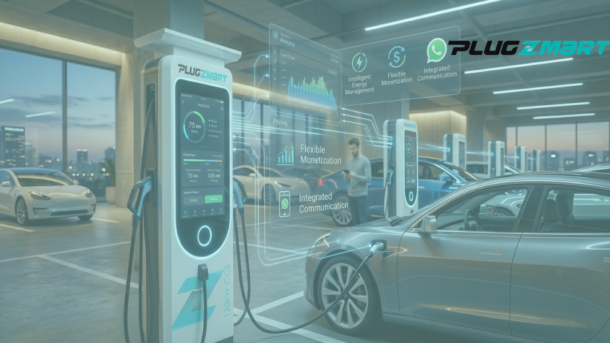
This shift is changing the role of charging management platforms. Plugzmart’s CMS SaaS platform is built around this evolving reality by helping charging businesses manage energy distribution, monetization, and communication through a centralized software layer.
The Next EV Charging Challenge Is Not Always Power Availability
As EV charging expands into apartments, workplaces, fleet depots, malls, and commercial properties, electricity demand becomes less predictable. Multiple vehicles charging simultaneously can create sudden spikes in power consumption, especially in locations with limited electrical infrastructure.
Traditional charging setups often distribute power uniformly without accounting for changing demand conditions. Over time, this creates pressure on transformers, site infrastructure, and operating costs.
The challenge is becoming more visible in dense urban deployments where parking spaces increase faster than available electrical capacity. Adding more chargers does not automatically solve the issue if energy distribution remains inefficient.
Why Dynamic Load Management Is Becoming Critical
Dynamic Load Management (DLM) is increasingly becoming an important software capability within EV charging networks because it allows charging power to be distributed intelligently based on real-time demand conditions.
Instead of allocating fixed power levels to every charger, DLM adjusts charging output dynamically depending on:
- Active Charging Sessions
- Site Load Conditions
- Available Power Capacity
- Priority Rules
This allows operators to support more vehicles without immediately upgrading electrical infrastructure.
Plugzmart’s CMS SaaS platform includes Dynamic Load Management capabilities designed to help operators optimize energy utilization while maintaining operational stability. As charging density increases, intelligent power distribution becomes less of a feature and more of an infrastructure requirement.
One Pricing Model No Longer Fits Every Charging Network
The charging industry has also become more diverse. Public charging stations, fleet hubs, apartment deployments, and workplace charging environments operate under very different usage patterns.
A fleet operator may prefer volume-based pricing. Residential users may require lower overnight tariffs. Commercial parking environments may choose time-based charging structures.
Rigid pricing models often create operational limitations because they assume all users behave similarly. Real charging environments rarely work that way.
This is one reason charging businesses are increasingly looking toward CMS SaaS platforms that support flexible monetization strategies.
Why Custom Tariffs Matter as Networks Scale
Custom tariffs allow charging operators to create pricing structures based on operational needs instead of applying one pricing system everywhere.
Examples include:
- Peak-Hour Pricing
- Fleet-Specific Tariffs
- Workplace Charging Policies
- Residential Charging Rates
- Promotional Pricing Structures
Plugzmart’s CMS SaaS platform supports custom tariff management, allowing operators to adapt pricing based on business objectives and user behaviour.
As charging businesses expand into different segments, pricing flexibility becomes an important operational capability rather than simply a billing function.
EV Charging Is Becoming a Communication Business Too
There is another shift happening that receives less attention. Charging businesses are also becoming communication businesses.
Drivers today interact with multiple applications every day:
- Navigation Platforms
- Payment Apps
- Charging Networks
- Mobility Services
Adding another application layer for every interaction creates unnecessary friction. Users increasingly expect charging information to reach them through tools they already use regularly.
This is changing how charging businesses think about customer interaction.
Why Messaging Platforms Are Becoming Part of Charging Infrastructure
Communication around charging sessions goes far beyond transaction alerts. Users often need:
- Charging Session Updates
- Payment Confirmations
- Reminders
- Receipts
- Support Information
- Charger Status Notifications
Plugzmart’s CMS SaaS platform includes WhatsApp integration as part of its communication workflow capabilities. Instead of requiring users to repeatedly switch platforms, charging businesses can interact through communication channels already embedded into everyday behaviour.
For operators, this improves responsiveness and reduces user friction. For drivers, the charging experience becomes more connected and easier to navigate.
EV Charging Networks Are Starting to Behave Like SaaS Businesses
One of the biggest shifts happening across the industry is that EV charging companies increasingly operate like software businesses rather than pure infrastructure providers.
Earlier conversations focused heavily on hardware specifications and charging speed. Today operators are paying closer attention to:
- Intelligent Energy Management
- Pricing Flexibility
- Communication Workflows
- Operational Automation
- Analytics
- User Experience
Plugzmart’s CMS SaaS platform is designed around this software-first approach. Instead of functioning as a monitoring dashboard attached to hardware, the platform acts as an operational layer that helps businesses manage charging infrastructure more efficiently.
The charger remains the visible part of the network. Increasingly, software determines how effectively the network performs underneath it. As charging ecosystems become larger and more complex, operational intelligence may become just as important as charger deployment itself.
FAQS
How does smart energy management help EV charging?
It balances power across chargers in real time, reducing overloads and improving charging efficiency.
Why are flexible tariffs important in EV charging?
They allow operators to offer pricing based on usage, location, fleets, or charging time.
Why is communication important in EV charging?
It keeps drivers informed with charging updates, payments, and alerts for a smoother experience.