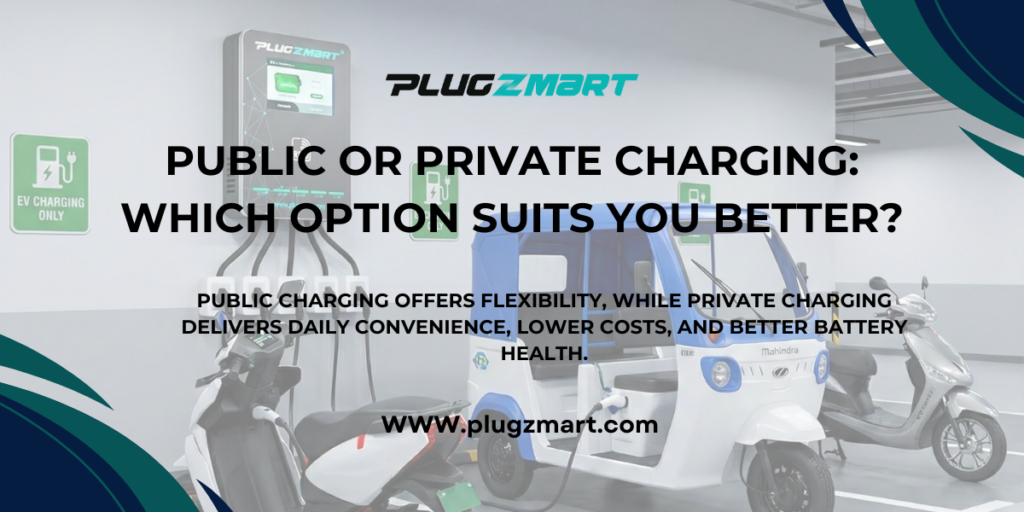
One of the first decisions EV owners face is whether to depend on public charging stations or install a private EV charger at home or work. Both options work well, but they serve different needs. The right choice depends on your routine, the kind of EV you drive and how often you actually need fast charging.
Let us break it down in a way that is genuinely helpful.
Start With How You Use Your EV
Here is the thing: your charging choice depends more on your lifestyle than your battery size. If your daily drive falls between 10 and 40 km, a private AC charger like a 3.3 kW, 7.4 kW or 22 kW home unit is more than enough. Plug in at night, wake up full, repeat. This is why so many EV owners install home chargers from EV charger manufacturers in India such as Plugzmart, Delta or Exicom.
If you are someone who travels longer distances or works across different routes, public DCfast charging gives you flexibility. A DC fast charger for EV in India, whether 30 kW, 60 kW or higher can top your battery quickly and get you moving again.
Different needs, different tools.
Where Public Charging Makes Sense
India’s public charging network has grown fast, especially with EV charging stationmanufacturers in India installing DC chargers on highways, malls, hotels, and commercial hubs.
Public charging is useful when:
- You are taking long road trips
- You live in an apartment with no wiring permissions
- You manage irregular work routes
- You want quick top-ups during the day
But public stations can be unpredictable. Sometimes they are busy, sometimes they are offline, and sometimes they are too slow for your EV. So, most drivers treat public charging as a backup, not the main plan.
Where Private Charging Wins
A private home charger gives you complete control. Timing, tariff, and convenience. You do not wait. You do not travel. You do not depend on apps telling you whether a charger is free.
Many EV users choose Plugzmart EV chargers, especially in Chennai and South India, because they get:
- ARAI-approved hardware
- Indian weather-proof enclosures
- Smart features like load management and scheduling
- Compatibility with most cars
- Integration with an EV charging CMS
That is a setup that keeps daily charging stress-free.
For most households, this becomes the default charging method simply because it works smoothly.
Cost Matters Too
Public charging looks cheaper at first because you avoid installation costs. But once you start using your EV daily, private charging typically wins:
- Home electricity tariffs are lower
- No travel to charging stations
- No idle fees
- Reduced dependency on DC fast charging
This is why working with EV charger manufacturers in Chennai or other local providers often pays off. The hardware is tested for Indian voltage fluctuations, and support is easier.
Public charging helps when you need flexibility.
Private charging helps when you want predictability.
Infrastructure Is a Silent Deciding Factor
If you own an independent house, installing a charger is simple. Apartments, however, require approvals from associations, builders, or facility teams. Many new buildings now follow state mandates, like those in Tamil Nadu that require EV readiness from day one.
This shift has made AC charger manufacturers and EV charger manufacturing companies in India more important than ever. Companies like Plugzmart help developers integrate AC and DC chargers cleanly without messy retrofits.
Public infrastructure is improving, but you cannot rely on growth speed alone when you need daily charging.
Battery Health Is Easier to Maintain at Home
A lot of new EV owners do not realise this, but your battery prefers slower AC charging.
Fast DC charging is great on highways, but using it every day warms the battery and increases wear.
If you want your battery to last years without losing range:
- Charge at home regularly
- Use fast charging only when you need it
- Keep charging habits consistent
Private chargers naturally support this healthier cycle.
So Which Option Suits You Better?
Here is the simplest way to think about it:
Choose private charging if you want convenience, lower cost, and better battsery health.
Use public charging when your trips require speed, distance or you do not have access to a home charger.
Most EV owners end up using both. But they rely on private charging to keep their everyday routine smooth and turn to public DC charging when the road calls for it.
If you are trying to figure out which charger fits your home, apartment, or commercial building, Plugzmart can help you understand load options, wiring and charger selection without overcomplicating anything.
FAQs
Is public charging enough if I use my EV daily?
Public charging can support occasional or long-distance use, but for daily commuting, relying only on public chargers can be inconvenient due to availability, wait times, and higher tariffs. Most daily EV users prefer private charging for consistency.
What type of charger is best for home use?
For most homes, AC chargers such as 3.3 kW, 7.4 kW, or 11 kW are ideal. They are cost-effective, battery-friendly, and sufficient for overnight charging.
Does frequent DC fast charging affect battery life?
Yes. Regular DC fast charging generates more heat and can accelerate battery degradation. It is best used for highway travel or quick top-ups, not as a daily charging method.