The EV charging industry has spent the last few years focused on deployment. More chargers, more locations, and faster network expansion became the primary indicators of growth. Public charging infrastructure expanded rapidly across cities, highways, commercial buildings, and fleet depots as EV adoption accelerated.
That phase is still continuing, but the conversation inside the industry is starting to change.
For many Charging Point Operators (CPOs), the difficult part is no longer installing chargers. The difficult part is operating a charging business efficiently after deployment. Questions around revenue cycles, network visibility, utilization, and interoperability are beginning to influence business performance more than charger count alone.
This shift is pushing EV charging closer to a software-driven operating model where CMS SaaS platforms play a larger role in daily operations than many operators initially expected. Plugzmart’s CMS SaaS platform is built around this operational layer, helping charging businesses manage infrastructure, revenue flow, and network accessibility through a centralized software ecosystem.
Charger Deployment Does Not Automatically Create Utilization
A charging station can be technically operational and still remain underutilized. This problem is becoming increasingly common as networks grow.
In many cases, the issue is not infrastructure quality. It is visibility. Drivers discover charging stations through apps and charging platforms. If a charger exists only within a closed ecosystem, its reach becomes limited to that platform’s users.
This creates a situation where chargers may remain physically available while large sections of EV users never discover them during route planning or charging searches. As networks expand, this fragmentation starts affecting utilization and revenue generation.
The industry’s response to this problem is interoperability. More charging businesses are beginning to treat charger visibility as a software challenge rather than only an infrastructure challenge. This is where modern EV charging CMS SaaS platforms are becoming operationally important rather than simply administrative tools.
Why OCPI Integration Is Becoming Operationally Important
OCPI integration was initially viewed as a roaming feature. Today it is increasingly becoming part of infrastructure strategy.
As charging ecosystems become more crowded, operators want chargers to appear across multiple networks and mobility platforms instead of remaining locked into a single application. Greater visibility improves the likelihood of charging sessions, especially in high-traffic urban areas and highway corridors where multiple networks overlap.
This is one reason EV charging companies are investing more heavily in CMS SaaS platforms that support interoperability and network expansion through software integrations.
Plugzmart’s CMS SaaS platform approaches this from an operational perspective. By supporting OCPI integration, the platform allows charging businesses to improve charger discoverability across ecosystems while maintaining centralized operational control. Operators can expand network visibility without losing control over pricing, monitoring, or charger management workflows.
For operators, this changes the role of software within charging infrastructure. The CMS is no longer only a monitoring dashboard. It becomes part of the revenue and utilization strategy itself.
Cashflow Is Becoming a Daily Operational Concern
Another shift happening inside the EV charging industry involves settlement cycles and revenue flow.
Charging businesses operate with recurring operational expenses:
- Electricity Costs
- Maintenance Teams
- Service Logistics
- Backend Software Infrastructure
- Site Lease Payments
While deployment receives most of the public attention, long-term operations depend heavily on healthy cashflow. Delayed payouts can create pressure on growing charging networks, especially for operators managing multiple locations simultaneously.
This issue becomes more noticeable as utilization increases and charging businesses begin operating at larger scale. Revenue may technically exist on paper while operational liquidity remains constrained because settlements move slowly through different platforms or billing cycles.
Why Daily Payouts Matter More as Networks Scale
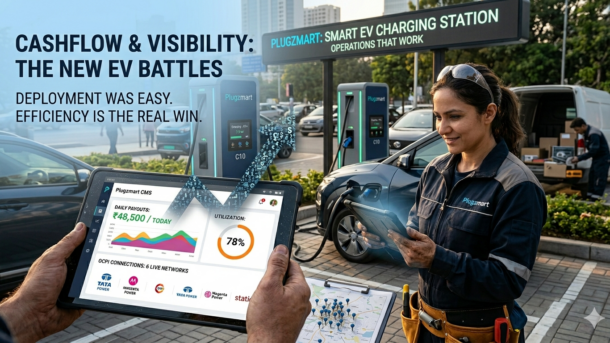
Daily payouts are starting to become an important feature within modern EV charging CMS SaaS platforms because they reduce friction between charging activity and operational cashflow.
For operators, faster settlements improve:
- Working Capital Management
- Electricity Bill Handling
- Maintenance Responsiveness
- Vendor Coordination
- Expansion Planning
This is particularly relevant for businesses operating public charging infrastructure where revenue consistency directly affects operational stability.
Plugzmart’s CMS SaaS platform includes daily payout capabilities as part of its software infrastructure layer, helping charging businesses maintain smoother cashflow cycles while scaling deployments. Instead of waiting through long settlement periods, operators gain faster access to operational revenue, which improves responsiveness across maintenance and expansion activities.
The significance of this feature is less about convenience and more about operational predictability. As EV charging businesses mature, financial responsiveness becomes just as important as charger uptime.
The EV Charging Industry Is Becoming Increasingly Software-Driven
One of the more interesting changes happening across the sector is how software is gradually becoming central to charging network operations.
Earlier conversations focused heavily on hardware specifications and charging speed. Those factors still matter, but operators are now paying closer attention to:
- interoperability
- payout automation
- tariff flexibility
- load management
- network analytics
- communication workflows
These functions are increasingly handled through CMS SaaS platforms rather than standalone hardware systems.
Plugzmart’s CMS SaaS platform is designed around this transition. Instead of treating software as a secondary layer attached to hardware, the platform focuses on helping charging businesses manage operations, monetization, and ecosystem connectivity through a unified SaaS environment.
In practice, the charging industry is beginning to resemble other infrastructure sectors where software determines operational efficiency. The charger remains the visible layer of the network, but the CMS SaaS platform increasingly controls how efficiently the ecosystem functions underneath.
Visibility and Cashflow Are Directly Connected
What makes these two challenges interesting is that they are closely related. Better visibility improves charger utilization. Better utilization improves revenue consistency. Faster payouts improve operational flexibility.
This creates a cycle where software infrastructure starts influencing business performance more directly than hardware deployment alone.
As EV adoption continues to grow, operators will likely compete less on charger count and more on how efficiently their networks operate. Visibility across platforms, smoother settlements, and intelligent operational management are becoming important parts of that equation.
The Industry Is Moving Beyond Installation Metrics
The early phase of EV infrastructure expansion rewarded rapid deployment. The next phase appears to be rewarding operational efficiency.
For charging businesses, this means infrastructure planning increasingly depends on software capabilities alongside hardware selection. CMS SaaS platforms are evolving from support tools into operational backbones that influence utilization, revenue movement, and ecosystem connectivity.
Plugzmart’s CMS SaaS platform reflects this broader industry shift by combining interoperability, payout automation, and charging network management into a software-first operational layer for EV infrastructure businesses.
As charging networks become larger and more interconnected, the companies that manage visibility and cashflow efficiently may gain a stronger long-term advantage than those focused only on deployment scale.
FAQS
Why does charger deployment not guarantee profit?
A charger can be fully functional but remain empty if it is hidden in a closed app ecosystem. Drivers can’t use what they can’t discover on their navigation maps.
What is OCPI and why does it matter?
OCPI is a protocol that connects different charging networks. It allows your chargers to appear on multiple third-party apps, drastically boosting visibility and station utilization.
How do slow settlement cycles hurt operators?
Charging networks face immediate daily costs . Delayed payouts squeeze liquid cashflow, making it hard to manage daily operations even if the business is profitable on paper.